
The automotive ecosystem is generating more operational data than ever before. Every journey creates information about vehicle movement, mileage, maintenance requirements, parts consumption and operating conditions. Yet much of this data remains fragmented across vehicle owners, fleets, workshops, spare parts businesses and financial institutions.
This creates a significant data and risk blindspot.
Vehicle owners face unexpected breakdowns and rising maintenance costs. Workshops operate with fragmented service information. Spare parts businesses struggle with inventory visibility. Financial institutions have limited operational data to accurately assess vehicle and ecosystem risk. At the same time, one important source of information is often completely overlooked: the road itself.
Potholes, road shocks, rough surfaces and other road anomalies directly affect vehicle components, tyres, suspension systems, operating costs and vehicle longevity. However, road-condition data is rarely captured continuously at the vehicle level.
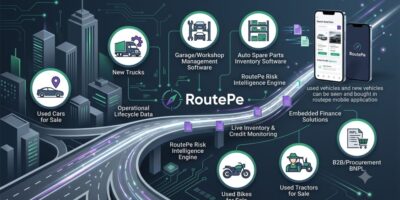
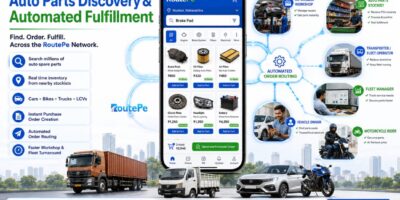
RoutePe is addressing this broader problem by bringing vehicle, maintenance, inventory and road-condition intelligence into one connected ecosystem.
The Automotive Data Blindspot
Traditional automotive systems tend to focus on individual functions.
A workshop management platform may manage jobs and service records. An inventory system may track spare parts. A vehicle application may provide basic vehicle information. A navigation application may provide routing.
But these systems often operate independently.
The result is fragmented operational intelligence.
A vehicle owner may know that a vehicle needs servicing, but may not have a complete picture of how driving conditions are affecting the vehicle. A workshop may know what was repaired previously, but not necessarily have continuous visibility into the vehicle’s operating environment. A spare parts business may know what is currently in stock, but may struggle to anticipate future demand.
RoutePe approaches the problem differently by connecting these operational signals.
Its ecosystem can bring together vehicle owners, fleets, workshops, spare parts businesses and other automotive stakeholders around shared operational intelligence.
Road Conditions Are Part of Vehicle Health
Predictive maintenance is generally associated with mileage, service history and component wear.
But the environment in which a vehicle operates also matters.
Repeated exposure to potholes, road bumps and rough surfaces can contribute to additional stress on tyres, suspension components and other vehicle systems. A route that repeatedly produces severe road shocks can therefore become an important part of understanding vehicle operating conditions.
This is where RoutePe’s Road Anomaly Intelligence capability becomes relevant.
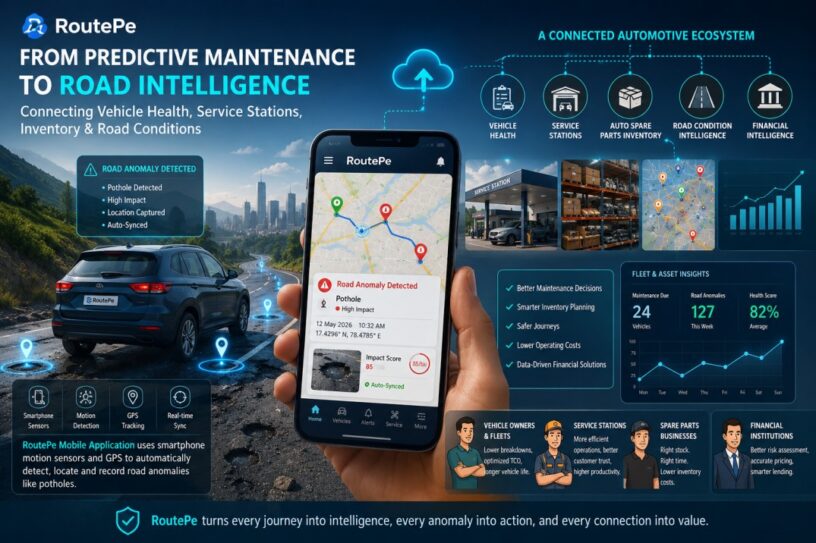
Using smartphone motion sensors and GPS, the RoutePe Mobile Application can detect significant motion events while a vehicle is travelling. The system analyses acceleration patterns, vehicle speed and GPS position to identify road anomalies and record their locations.
The objective is not simply to identify a single pothole.
The larger opportunity is to build a continuously improving picture of road conditions from real-world vehicle journeys.
From Individual Detection to Crowdsourced Road Intelligence
One vehicle encountering a road shock does not necessarily prove that a pothole exists.
The same type of event could be caused by a speed breaker, rough surface, road joint or another physical disturbance.
That is why a scalable road intelligence system can become more powerful as more vehicles contribute data.
If multiple vehicles repeatedly record significant anomalies within the same geographic area, RoutePe can begin building confidence around that location. Over time, repeated detections can help distinguish persistent road conditions from isolated events.
This creates the foundation for a crowdsourced road-condition network.
Instead of relying entirely on manually reported potholes, road-condition intelligence can be generated passively from vehicle journeys.
That data can eventually support route awareness, vehicle protection, fleet analysis and road-condition mapping.
Connecting Road Intelligence With Predictive Maintenance
The real value emerges when road-condition intelligence is connected to maintenance intelligence.
Consider a fleet vehicle that repeatedly travels through a road segment generating high-impact events.
That information can become another operational signal alongside mileage, service history and maintenance schedules.
Instead of looking at vehicle maintenance in isolation, RoutePe can help create a broader view:
Vehicle + Driving Pattern + Maintenance History + Road Conditions + Parts Consumption
This can improve the context around maintenance decisions.
For example, repeated high-impact road events could help explain why certain vehicles require more frequent suspension or tyre-related attention. Workshop teams could potentially use this information alongside service history when assessing recurring issues.
The goal is not to claim that every road anomaly causes a component failure. Rather, road-condition data becomes another useful signal in understanding vehicle operating conditions.
Supporting Workshops Across Vehicle Categories
The same intelligence layer can support different types of automotive service businesses.
A Bike Workshop may benefit from understanding recurring road conditions affecting two-wheelers, particularly where tyres, wheels or suspension components experience repeated impacts.
A Car Workshop can use vehicle history and operating information as additional context when servicing customer vehicles.
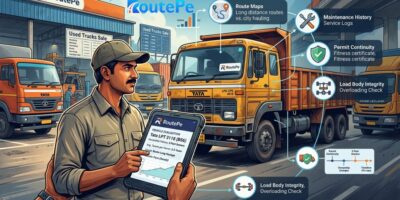
A Truck Workshop can potentially benefit even more from operational road-condition data because commercial vehicles frequently operate across long distances and diverse road environments.
This intelligence can complement existing Garage Management and Workshop Management processes rather than replacing them.
A workshop’s core job remains service and repair. RoutePe’s role is to provide better operational information around those activities.
Connecting Maintenance With Spare Parts
Road-condition intelligence can also connect naturally with the spare parts ecosystem.
Workshop demand is ultimately connected to vehicle usage, component wear and repairs. When operational data becomes more structured, it can contribute to better understanding of future maintenance requirements.
This has implications for Auto Spare Parts Inventory.
Instead of relying entirely on historical sales patterns or manual estimates, inventory intelligence can eventually incorporate additional signals from vehicles and workshops.
For example, if a particular vehicle population is experiencing increasing demand for a certain category of repair, that information could become relevant to inventory planning.
This creates a potential connection between:
Vehicles → Maintenance → Workshops → Parts Demand → Inventory
That connected view is particularly valuable in an automotive ecosystem where inventory can represent significant working capital.
Reducing Operational Friction for Workshops
Many workshops still depend heavily on manual processes.
Service information, customer communication, vehicle history, parts requirements and operational activities can become fragmented across spreadsheets, paper records and disconnected applications.
RoutePe’s broader platform approach is intended to bring these workflows closer together.
Whether it is a small independent garage or a larger commercial workshop operation, digital visibility can help reduce the friction involved in managing vehicles, jobs, maintenance requirements and parts.
The objective is not simply to digitise individual tasks.
It is to connect the information generated by those tasks.
That distinction matters because the value of automotive data increases when it can be used across multiple operational functions.
From Vehicle Data to Financial Intelligence
There is also a financial dimension to this problem.
Banks, NBFCs and insurers need better information to assess vehicle and fleet risk. Yet traditional financial assessments may have limited access to continuously updated operational information.
Vehicle usage, maintenance behaviour, repair history, inventory transactions and road-condition exposure can potentially contribute to a richer operational picture.
RoutePe’s long-term opportunity is therefore broader than maintenance software.
It is about creating an operational intelligence layer that can support automotive commerce, maintenance and financial services.
Better operational data can create the foundation for better-informed decisions.
The RoutePe Mobile Application as the Data Collection Layer
At the centre of this ecosystem is the RoutePe Mobile Application.
A smartphone already contains several sensors capable of generating useful vehicle and journey information. This creates an opportunity to collect operational signals without requiring dedicated hardware for every use case.
For road anomaly detection, the application can monitor motion events and associate significant anomalies with GPS coordinates and vehicle information.
For vehicle operations, the same mobile environment can support other connected functions such as mileage tracking and maintenance intelligence.
This makes the smartphone more than a user interface.
It can become an operational sensing layer for the automotive ecosystem.
Building a More Connected Automotive Ecosystem
The automotive industry does not suffer from a lack of data.
It suffers from fragmented data.
Vehicle owners have one set of information. Workshops have another. Parts businesses have another. Financial institutions have another. Road-condition information is often disconnected from all of them.
RoutePe’s opportunity is to connect these signals.
Road anomaly intelligence adds another important dimension to that vision by treating the road itself as a source of operational data.
The result is a broader intelligence model:
Vehicle intelligence + Maintenance intelligence + Workshop intelligence + Inventory intelligence + Road intelligence + Financial intelligence
This creates possibilities far beyond a conventional workshop or inventory application.
RoutePe can evolve toward an automotive infrastructure platform where every journey contributes useful operational information, every maintenance event adds context, and every road anomaly becomes another data point.
The ultimate objective is simple: make the automotive ecosystem more visible, predictive and connected. From the vehicle on the road to the workshop, the spare parts network and the financial ecosystem supporting it.