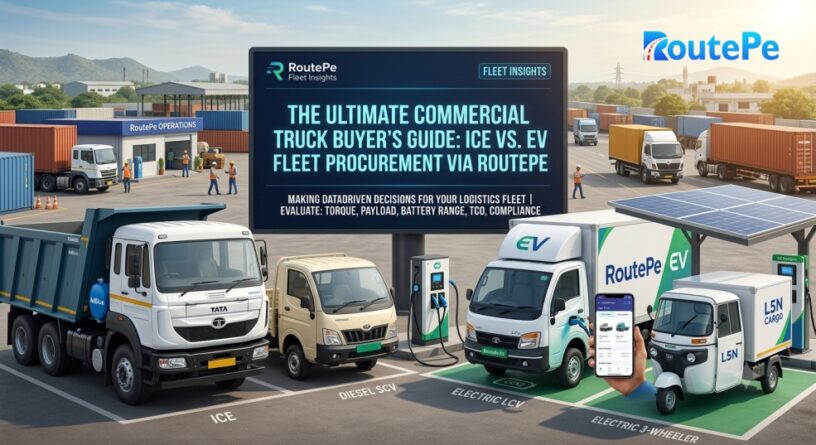

Buying a commercial vehicle, whether expanding a fleet or purchasing a single new truck, is one of the most significant investments for any logistics business. Beyond the initial price tag, the choice impacts total cost of ownership (TCO), fuel/charging efficiency, payload capabilities, and compliance with statutory regulations.
With the RoutePe mobile application, discovering and procuring new commercial trucks is streamlined. Rather than visiting multiple dealerships to gather scattered quotes and paper brochures, RoutePe offers a unified marketplace directly on your smartphone. You can explore multi-brand commercial vehicle catalogs, view transparent pricing, assess technical specs, and lock in vehicle financing or fleet intelligence, all from one app.
Below is an extensive guide to evaluating Internal Combustion Engine (ICE) trucks and Electric Commercial Vehicles (EVs) to ensure your fleet investment delivers maximum profitability.
Mastering ICE Commercial Truck Purchases
Evaluating 3-Wheelers (L5N Cargo)
For last-mile urban delivery, low-end torque matters more than peak horsepower. High torque at low RPMs ensures that single-cylinder diesel or CNG engines can haul payloads between 500 kg and 750 kg up steep flyovers and through congested city lanes without stalling.
Selecting Mini-Trucks (SCV)
Small Commercial Vehicles (SCVs) require matching cargo deck lengths (typically 7 ft to 9.2 ft) with payload density. Ensure the chassis features heavy-duty hydroformed cross-members and semi-elliptical leaf springs to withstand continuous intra-city loading cycles without structural distortion.
Configuring Light Commercial Vehicles (LCV)
Regional distribution calls for 1.5L to 3.0L turbo-diesel engines paired with overdrive gearboxes. Opt for OEM factory-built High Side Decks (HSD) or closed containers. Factory bodies preserve OEM warranty coverage, maintain proper axle-weight balance, and offer optimized aerodynamics compared to local aftermarket builds.
Heavy Commercial Vehicles (HCV) & SCR Standards
For multi-axle haulage ranging from 19T to 55T GVW, select 5.0L to 6.7L engines producing 200+ HP equipped with Selective Catalytic Reduction (SCR) systems. Factor in Diesel Exhaust Fluid (AdBlue) consumption, which runs roughly 3% to 5% of total diesel usage. Live telemetry integration is vital to monitor DEF levels continuously and prevent unexpected engine derating on long routes.
Navigating Tipper & Dump Truck Regulations
Tippers must strictly adhere to Central Motor Vehicles Rules (Rule 138B). Key technical parameters include:
- Automated Load Cover: Tippers must feature fully automated mechanical, hydraulic, or electrical cover systems operated directly from inside the cabin to stop material spillage.
- Audio-Visual Warnings: Dashboard alerts must warn the driver if the tipper bed is elevated or if the top cover remains open.
- Height Exemption (Rule 93): The mechanical cover hardware is excluded when calculating statutory maximum vehicle height.
- Hydraulic Assembly: Select heavy-duty multi-stage tipping cylinders and deep crawler gear ratios for steep site gradients.
Tractor-Trailer & GCW Configurations
Match tractor head power (280 HP to 300+ HP) and axle ratios to the specific trailing equipment, whether flatbeds, skeleton container chassis, or tip-trailers. Verify kingpin size (2-inch versus 3.5-inch) and air-suspension leveling valves to protect structural integrity under maximum Gross Combination Weight (GCW).
Evaluating Electric Commercial Vehicles (EVs)
Electric 3-Wheelers (L5N Cargo)
Prioritize Lithium Iron Phosphate (LFP) battery chemistry (7.5 kWh to 13 kWh) for its thermal stability during high ambient temperatures. Evaluate usable deck space against rated payloads (500 kg to 688 kg) to verify a realistic operating range of 90 km to 120 km under full load.
Electric Mini-Trucks (SCV)
Look for liquid-cooled battery packs (17 kWh to 21 kWh) combined with high-torque electric motors (100+ Nm) built for frequent stop-and-go e-commerce runs. Fast DC charging support (10% to 80% in under 105 minutes) is essential for multi-shift operation.
Electric LCVs & Charging Standards
For 1.2T to 2.0T payload mid-mile haulers, evaluate battery capacities between 25 kWh and 40+ kWh alongside CCS2 fast-charging compatibility. Insist on a minimum 5-year or 1,50,000 km traction battery warranty with strict State of Health (SoH) guarantees.
Avoid Misleading Metrics
Certified MIDC/CIDC range figures reflect unladen, ideal testing conditions. Fleet managers should evaluate usable kWh capacity, real-world kWh/km consumption under full payload, and regenerative braking efficiency in dense traffic.
Comparison: ICE vs. EV Commercial Fleets
| Parameter | ICE Commercial Vehicles | Electric Commercial Vehicles |
| Primary Use Case | Long-haul interstate routes & heavy payloads | Intra-city, last-mile & regional distribution |
| Upfront Vehicle Cost | Lower initial purchase price | Higher initial capital expenditure |
| Running Cost | Subject to fluctuating diesel/CNG prices | Significantly lower cost-per-kilometer |
| Maintenance | Higher maintenance (oil, filters, engine wear) | Lower maintenance (fewer moving parts) |
| Turnaround Strategy | Quick refueling at widespread fuel stations | Requires depot infrastructure & DC fast charging |
| Telematics Focus | Fuel tracking, DEF/AdBlue levels, engine diagnostics | Battery SoH, cell balancing, live State of Charge |
Pre-Delivery Inspection (PDI) Checklist
Before authorizing final RTO registration or disbursing payments, conduct a complete pre-delivery audit:
[Vehicle Identification & Mechanical PDI]
  │
  ├── VIN & Frame Check: Match chassis stamp on frame with Invoice, Form 21, and Form 22 certificates.
  ├── Chassis Integrity: Check leaf spring alignment, U-bolt torques, frame rivets, and axle seals.
  ├── Pneumatic Systems: Pressure test dual-circuit air brakes, ABS valves, and air tank drain valves.
  └── Fluid & Emission Systems: Check oil levels, coolant, transmission fluid, and DEF tank purity.

[EV Electrical & Diagnostics PDI]
  │
  ├── Live OBD Diagnostics: Run scan to verify 100% Battery State of Health (SoH) and zero cell imbalance.
  ├── Underbody Inspection: Inspect skid plates, battery casing, and IP67/IP69K motor seals for transit damage.
  ├── High-Voltage Wiring: Check orange insulation looms for pin wear or structural damage.
  └── Charging Verification: Test both portable AC chargers and fast DC gun latching functionality.
Compliance, Telematics, and Delivery Day Documentation
Telematics & Safety Integration
Commercial trucks require government-mandated AIS-140 compliant GPS trackers featuring panic buttons and certified Speed Limiting Devices (capped at 80 km/h or local speed regulations). OEM telematics platforms integrated into fleet dashboards streamline driver scoring, route optimization, and live fault diagnosis.
Delivery Day Document Checklist
- National Permit (NP) & Fitness: Secure Form 48 (National Permit authorization), tax receipts, and initial fitness certificates.
- FASTag & Vahan Linkage: Verify that your commercial class FASTag links directly to your vehicle’s record on the Vahan portal.
- SLD Calibration Certificate: Ensure you hold an official calibration certificate for the speed governor for RTO endorsement.
- Green-Plate & Subsidy Clearances (EVs): Verify Vahan green-plate registration under correct motor power (kW) ratings and confirm state/central EV subsidies reflect on your final invoice.
- Serial Number Verification: Match physical battery pack serial numbers, motor unit IDs, and chassis numbers against your tax invoice.
Streamlining Fleet Buying with the RoutePe App
Choosing between ICE and EV options requires clear data and access to transparent inventory. The RoutePe mobile application changes how business owners purchase trucks:
- Direct Access to New Commercial Models: Browse and discover new commercial trucks listed directly within the app, complete with up-to-date specs and configurations.
- Complete Pricing Transparency: View direct price breakdowns without hidden fees or surprise dealer markups.
- End-to-End Fleet Management: Beyond vehicle discovery, RoutePe supports operational management, from tracking live workshop repairs and monitoring part wear to managing vehicle health telemetry.
Download the RoutePe app on your mobile device to compare models, secure financing, and make confident, data-backed decisions for your fleet.
