For an automotive business, inventory is a constant balancing act.
Too little stock can mean a missed sale, a delayed repair or a customer who has to wait for a part. Too much stock can mean money sitting on shelves, occupying valuable space and becoming increasingly difficult to sell.
The challenge is not simply to maintain more inventory. It is to maintain the right inventory at the right time.
This is where RoutePe brings together two important parts of the automotive ecosystem: inventory management and predictive vehicle maintenance.
RoutePe provides auto spare parts inventory management solutions for auto spare parts dealers, garages, lubricant dealers and battery dealers, while its predictive maintenance platform helps vehicle owners understand the condition and remaining usage of individual vehicle parts based on actual vehicle usage and mileage.
Together, these capabilities point toward a more connected way of managing automotive parts, vehicles and maintenance.
Preventing Stock Shortages Starts With Visibility
A stock shortage rarely begins when the shelf becomes completely empty.
It begins earlier, when the available quantity starts falling below a useful level and the business does not notice it in time.
For an auto spare parts dealer, this could mean running short of a frequently requested brake component, filter, clutch component or electrical part. For a garage, it could mean discovering that a required replacement part is unavailable only after a vehicle has already entered the workshop.
For lubricant dealers, the shortage could involve a popular engine oil grade or packaging size. For battery dealers, it could involve a commonly requested battery specification.
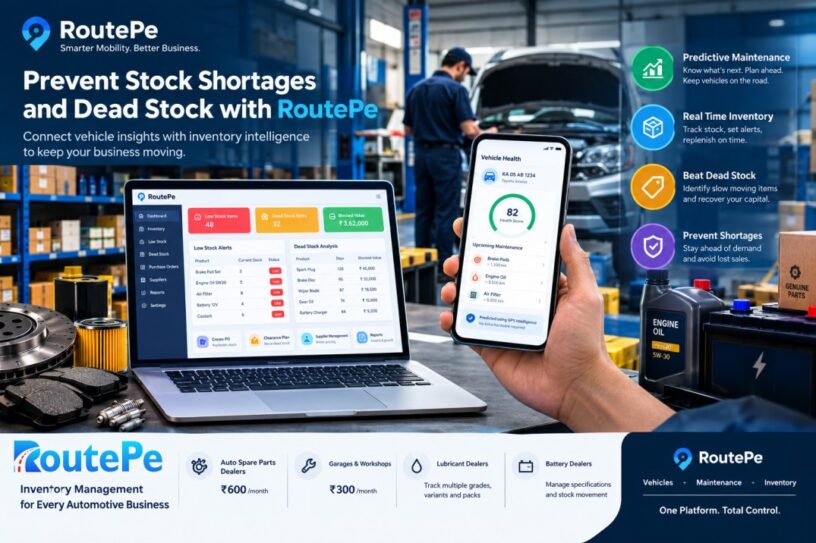
RoutePe inventory management is designed to make these situations easier to identify through low stock monitoring.
Instead of depending entirely on memory, physical shelf checks or spreadsheets, businesses can see which products are approaching their defined stock limits and take action before the shortage becomes a customer problem.
The objective is simple: identify the shortage before the customer does.
Low Stock Is Only One Side of the Problem
Preventing shortages is important, but automotive businesses face another inventory problem that can be just as damaging.
Dead stock.
Dead stock refers to inventory that has remained unsold or unused for an extended period. It represents money that has already been spent but is not generating movement or revenue.
A dealer may have products sitting on shelves for months while regularly selling other products. A garage may have parts that were purchased for expected demand but have not moved. Lubricants can remain stagnant when demand shifts between grades or packaging sizes. Batteries can also become difficult to move when particular specifications have lower demand.
This creates blocked capital.
The business may technically have a large inventory, but a significant portion of that inventory may not be contributing to sales.
RoutePe therefore looks at inventory from both directions.
Low stock identifies what may need to be purchased.
Dead stock identifies what may need to be moved.
That distinction is important because healthy inventory is not about having the maximum possible stock. It is about having useful stock.
From Stock Alerts to Better Purchasing Decisions
Once low stock becomes visible, the next step is deciding what to replenish.
A useful inventory system should help a business move from awareness to action.
RoutePe inventory management gives businesses a clearer view of their current stock position and the products that require attention. This allows a dealer or workshop to plan purchases around actual inventory conditions rather than simply placing orders based on habit.
For a spare parts dealer, this can help maintain availability of frequently moving products.
For a garage, it can help reduce situations where a vehicle is waiting because a required part was not planned for.
For lubricant and battery dealers, the same principle applies. Different products have different rates of movement, and inventory decisions should reflect that difference.
The goal is not to purchase everything in large quantities.
The goal is to replenish what is moving while controlling what is not.
Dead Stock Can Hide Working Capital
Dead stock becomes particularly important when viewed from a financial perspective.
Every product sitting unused represents capital that could potentially have been used elsewhere.
A dealer may have thousands of rupees tied up in products that have not moved for months. A workshop may have shelves containing parts that were purchased long ago but are no longer generating meaningful activity.
This is why identifying dead stock is more than an inventory housekeeping exercise.
It is a working capital exercise.
RoutePe helps garages through its garage management software to identify stagnant inventory so they can decide what to do next.
Depending on the product, that could mean offering a discount, creating a clearance strategy, combining products into an offer, returning eligible stock to a supplier or simply changing future purchasing behaviour.
The important thing is knowing that the stock has become inactive.
Without visibility, dead stock can remain invisible until it has already consumed valuable space and capital for a long period.
Where Predictive Vehicle Maintenance Changes the Picture
This is where RoutePe’s predictive vehicle maintenance capability adds another dimension to the inventory conversation.
Traditional inventory planning often looks backward.
It asks what sold previously and how much stock is currently available.
Predictive maintenance introduces another useful question.
What parts may be needed by vehicles in the future?
RoutePe’s predictive maintenance system follows actual vehicle usage through smartphone based mileage tracking and connects that information with the maintenance history of individual parts. It can provide a vehicle health indication, expected service intervals and remaining mileage for tracked maintenance items.
This means vehicle maintenance does not have to be viewed only as a reaction to a breakdown or a service visit.
It can become a planning activity.
When a vehicle’s tracked component approaches its expected service interval, the owner can have a clearer indication that attention may be required. This creates a useful connection with the automotive parts ecosystem.
The vehicle side can indicate what may be needed.
The inventory side can indicate what is available.
That creates the foundation for a more intelligent automotive supply chain.
Connecting Vehicle Demand With Inventory Availability
Imagine a vehicle owner whose brake component is approaching its expected replacement mileage.
The predictive maintenance system can indicate that the component is approaching attention based on the vehicle’s actual usage and maintenance history.
Now consider the other side of the ecosystem.
A garage or parts dealer can monitor its inventory and identify whether the relevant part is available, running low or sitting as excess stock.
These are two different problems, but they are closely connected.
One concerns future maintenance demand.
The other concerns current inventory availability.
RoutePe operates across both sides of this automotive environment.
The predictive maintenance platform helps make vehicle maintenance more understandable by showing individual parts, remaining mileage and health information. The inventory platform helps businesses understand what parts they have, what is running low and what stock is not moving.
The long term opportunity is to make these two forms of intelligence work even more closely together.
The Right Stock at the Right Time
The purpose of inventory management is therefore not simply to increase stock.
It is to improve stock quality.
A business should ideally have enough of the products that customers and vehicles are likely to need, while avoiding excessive purchases of products that remain inactive.
This becomes particularly important in the automotive sector because inventory can contain thousands of individual products and specifications.
A spare parts dealer may handle products across different vehicle models and applications.
A garage may need parts based on the vehicles currently being serviced.
A lubricant dealer may manage different grades, specifications and packaging sizes.
A battery dealer may maintain several battery types and capacities.
Trying to manage all of this through memory alone becomes increasingly difficult as the business grows.
RoutePe provides a digital layer for monitoring this inventory.
Inventory Management for Different Automotive Businesses
RoutePe’s inventory management approach is not limited to traditional spare parts dealers.
Auto spare parts businesses can use RoutePe to monitor stock, identify low stock products and identify dead stock.
Garages can use their inventory management system to monitor workshop inventory and understand which products require replenishment or are remaining inactive.
Lubricant dealers can monitor products across different grades, specifications and packaging variants without forcing them into an inventory structure designed for conventional spare parts.
Battery dealers can similarly manage their battery inventory and maintain visibility over products that need replenishment or are not moving.
The underlying principle remains the same.
Know what you have.
Know what is running low.
Know what is not moving.
Then make purchasing and selling decisions based on that information.
Better Inventory Can Also Improve Customer Service
Stock management ultimately affects the customer.
A customer does not see a stock dashboard.
They see whether the required product is available when they need it.
For a garage, that can mean completing a repair without unnecessary waiting.
For a spare parts dealer, it can mean fulfilling an order instead of losing the sale.
For a lubricant dealer, it can mean maintaining availability of popular products.
For a battery dealer, it can mean responding quickly when a customer needs a replacement.
Better visibility therefore has a direct operational benefit.
When businesses know what is running low, they can replenish earlier.
When they know what is sitting unused, they can work to release the capital tied up in it.
When vehicle maintenance information becomes more predictive, the wider automotive ecosystem can also begin thinking about demand before the maintenance event actually occurs.
RoutePe: Connecting Vehicles, Maintenance and Inventory
This is ultimately where RoutePe’s broader automotive platform becomes important.
RoutePe is not simply an inventory application.
Its inventory management products address the business side of automotive parts and workshop operations, while its predictive maintenance capability addresses the vehicle side.
Predictive maintenance helps answer questions such as:
How healthy is the vehicle?
Which parts are being tracked?
How much mileage remains?
Which component may require attention?
What maintenance has already been recorded?
Inventory management helps answer another set of questions:
What products are currently available?
Which products are running low?
Which products are not moving?
What stock needs to be replenished?
What stock may need a clearance strategy?
Bringing these perspectives together creates a more complete picture of the automotive ecosystem.
A More Balanced Approach to Inventory
The best inventory strategy is not maximum inventory.
It is balanced inventory.
Businesses need enough stock to serve customers without allowing excessive capital to become trapped in products that do not move.
They need early visibility into shortages without continually over purchasing.
They need to identify dead stock before it becomes a permanent burden.
And increasingly, they can benefit from understanding future maintenance requirements rather than looking only at past sales.
That is the direction RoutePe is building toward.
From the vehicle owner using predictive maintenance to understand remaining mileage and part health, to the garage monitoring its inventory, to the spare parts dealer managing stock, to lubricant and battery businesses maintaining product availability, the objective is the same.
Make automotive information more useful.
Make inventory decisions more informed.
And make maintenance more predictable.
RoutePe auto spare parts inventory management is available at ₹600 per month, while RoutePe garage inventory management is available at ₹300 per month.
Because preventing a stock shortage is not just about having more products on the shelf.
It is about knowing what will be needed, knowing what is available and knowing what should not be sitting there in the first place.
