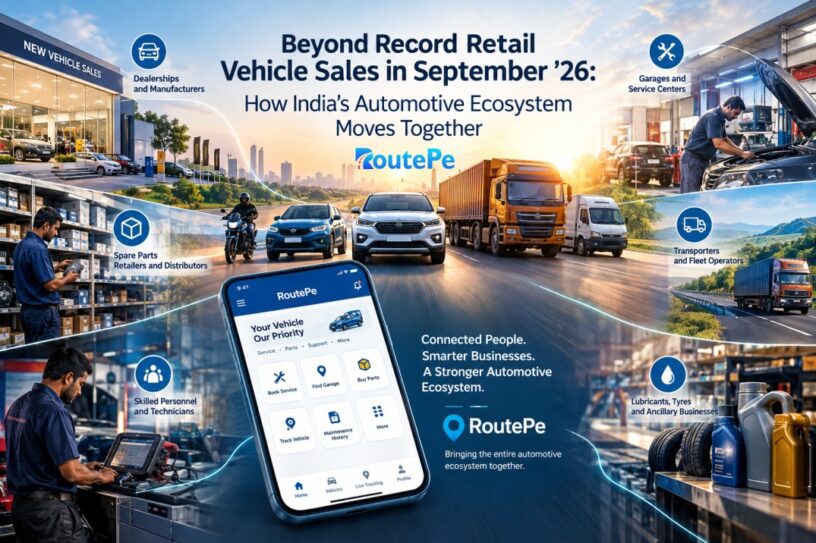



India’s automotive industry celebrated a historic milestone in September as retail vehicle sales recorded their strongest ever performance for the month. According to data released by the Federation of Automobile Dealers Associations, overall vehicle registrations grew by more than 31 percent year on year, crossing 25 lakh units across categories. Passenger vehicles, two wheelers, commercial vehicles, and electric vehicles all contributed to this momentum, reflecting rising consumer confidence, stronger financing availability, improving rural demand, and the beginning of the festive season.
Such headline numbers naturally attract attention toward vehicle manufacturers, dealerships, and new vehicle launches. However, the story of India’s automotive growth extends far beyond the showroom floor. Every vehicle sold creates a ripple effect that travels through a vast network of workshops, spare parts retailers, distributors, mechanics, transporters, technicians, and countless small businesses that form the foundation of the automotive aftermarket.
This is an aspect of the industry that often remains underappreciated despite being one of the largest employment generators in the country.
When a new vehicle enters the market, it does not simply represent a completed sale. It marks the beginning of a long lifecycle. Vehicles require periodic servicing, replacement parts, tyres, lubricants, batteries, insurance, roadside support, diagnostics, repairs, and upgrades. Commercial vehicles demand even greater attention because uptime directly affects business profitability. Every truck on the road supports drivers, fleet operators, workshops, parts dealers, and logistics providers.
The automotive industry therefore functions not as isolated segments but as an interconnected ecosystem.
India today has one of the world’s largest vehicle populations. With every strong sales month, the base of vehicles requiring maintenance and support expands further. A passenger car sold today will likely visit a workshop multiple times during its ownership cycle. A two wheeler rider may need periodic servicing, tyres, engine oil, or emergency repairs. A commercial vehicle operator depends on timely maintenance to avoid downtime. The cumulative effect of these activities creates a substantial economic engine that extends far beyond manufacturing.
For the aftermarket, strong vehicle sales are not merely encouraging numbers. They represent future business opportunities.
Auto spare parts retailers benefit through increased demand for components across categories. Lubricant distributors see higher consumption. Independent garages receive more service work. Skilled technicians gain employment opportunities. Parts stockists improve inventory movement. Logistics operators experience higher transport volumes. Training institutions find greater demand for skilled manpower. Even software and technology providers supporting these businesses become an integral part of the value chain.
This relationship between vehicle sales and aftermarket growth is particularly important in India because of the scale and diversity of the market. From motorcycles in small towns to premium passenger vehicles in cities and heavy commercial fleets operating across highways, every segment contributes to economic activity in unique ways.
Commercial vehicles deserve special attention in this context.
A truck or fleet vehicle is not simply a mode of transport. It is an economic asset that supports trade, commerce, agriculture, manufacturing, and retail distribution. Keeping such vehicles operational requires coordination among transporters, workshops, parts suppliers, fuel stations, tyre dealers, and service providers. As freight movement increases alongside economic growth, the demand for efficient vehicle maintenance and support services also rises.
This is where the role of technology becomes increasingly significant.
The automotive ecosystem has traditionally been fragmented. Vehicle owners often struggle to find reliable workshops, track maintenance history, source compatible parts, or manage service records. Workshops may face challenges in customer communication, job tracking, inventory management, and digital adoption. Spare parts dealers often depend on manual processes and disconnected systems.
The future of the industry lies not merely in selling more vehicles but in connecting all participants within a unified ecosystem.
Around the world, industries are moving toward platforms that improve visibility, transparency, and collaboration. The automotive sector is no exception. Digital infrastructure can help create stronger links between vehicle owners, workshops, parts suppliers, transporters, and service providers.
India is beginning to witness this transition.
Platforms such as RoutePe are working toward bringing together different stakeholders across the automotive ecosystem. The objective is not simply digitization for its own sake, but enabling smoother interactions among vehicle owners, garages, auto parts businesses, transport operators, and service providers. In a market as diverse as India, such integration can improve efficiency while creating opportunities for businesses of all sizes.
The importance of this approach becomes clearer when we consider the scale of employment supported by the automotive value chain.
For every vehicle manufacturer, there are thousands of small enterprises that operate behind the scenes. A local mechanic in a small town, a spare parts retailer in a city market, a workshop manager, a tyre dealer, a service advisor, a transporter, a warehouse operator, and a field technician all contribute to the movement of the industry.
Their contribution is immense, yet often invisible.
The next phase of automotive growth in India should therefore be measured not only by vehicle sales but also by the health of the ecosystem that supports those vehicles throughout their lifespan.
As electric vehicles become more common, as connected mobility expands, and as digital services gain importance, the aftermarket itself will evolve. New skills will emerge. New categories of service businesses will appear. Inventory systems will become smarter. Workshops will adopt digital workflows to optimise their Garage Management. Predictive maintenance and connected service models may gradually become part of everyday operations.
This evolution is not a challenge alone. It is also an opportunity.
India has the potential to create one of the world’s most integrated automotive ecosystems, where manufacturers, dealers, workshops, spare parts businesses, fleet operators, and technology platforms work together rather than in isolation.
September’s record retail performance is therefore more than a monthly statistic. It is a reminder of the depth and scale of the automotive economy. Every vehicle sold creates demand, supports livelihoods, and strengthens a network that stretches from factories and dealerships to local garages and neighbourhood spare parts shops.
The road ahead for India’s automotive sector is not defined only by production volumes or sales numbers. It is defined by the ability of the entire ecosystem to move together.
When vehicles move, businesses move.
When businesses move, livelihoods improve.
And when an entire automotive ecosystem grows in harmony, the benefits extend far beyond the road.