A vehicle rarely gives a clear warning before a minor problem turns into an expensive repair. Brake pads do not announce when they are nearing the end of their useful life. Engine oil does not tell the driver when it has deteriorated and needs replacement. Most vehicle components simply continue operating until their condition begins to affect performance, safety, or reliability.
By the time a driver notices an unusual sound, experiences reduced performance, or sees a warning light on the dashboard, the underlying problem may already require attention.
Traditional vehicle maintenance largely depends on fixed service schedules, dashboard warnings, manual inspections, and the driver’s ability to recognise early signs of trouble. While these methods remain important, they do not always provide an early enough indication of developing problems.
Intelligent predictive maintenance offers another approach. Instead of waiting for a vehicle to show obvious symptoms, it uses available data and learned patterns to help identify potential maintenance requirements before they become more serious.
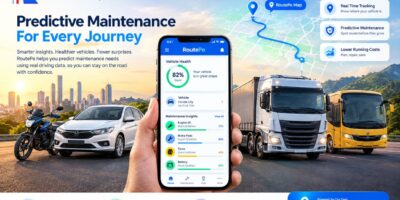
This is the idea behind RoutePe’s predictive maintenance technology, which uses smartphone GPS intelligence to help monitor vehicle health without requiring additional onboard tracking hardware.
Moving Beyond Traditional Vehicle Maintenance
Most vehicle owners follow one of two approaches to maintenance. They either service their vehicles according to a predefined schedule or wait until a problem becomes noticeable.
Both approaches have limitations.
A vehicle used extensively in congested city traffic may experience different operating conditions from one driven primarily on open highways. Two vehicles of the same model and age may also have very different maintenance requirements because of differences in usage, driving patterns, and operating conditions.
A fixed schedule cannot always account for these differences. Waiting for visible symptoms, meanwhile, can allow wear and tear to progress unnoticed.
Predictive maintenance aims to bridge this gap by analysing available information, identifying relevant patterns, and estimating when maintenance attention may be required.
For consumers, the objective is straightforward. It is to make vehicle maintenance more proactive, reduce uncertainty, and help prevent avoidable disruptions wherever possible.
Predictive Maintenance Without Additional Hardware
One of the practical barriers to intelligent vehicle monitoring has traditionally been the need for additional hardware. Depending on the system, vehicle owners may have to install tracking devices, connect diagnostic equipment, or purchase specialised monitoring solutions.
RoutePe takes a different approach by using proprietary GPS based intelligence through a smartphone.
The objective is to make predictive maintenance more accessible without requiring a separate device to be installed in the vehicle. This can reduce the additional equipment and installation involved in adopting a vehicle monitoring solution.
Using smartphone location data and intelligent analysis, the technology aims to identify patterns associated with vehicle usage and generate useful vehicle health insights.
The approach is particularly relevant to everyday consumers who want a simpler way to understand their vehicles, as well as commercial vehicle operators who need better visibility into vehicle usage and maintenance planning.
However, it is important to understand what this technology does. GPS based intelligence is not the same as directly measuring brake pad thickness, testing engine oil quality, or reading every diagnostic code from a vehicle’s electronic systems. Predictive assessments are intended to support maintenance decisions, not replace physical inspections or professional diagnosis.
The value lies in helping drivers become more aware of potential maintenance needs before those needs turn into larger problems.
Understanding the Role of Artificial Intelligence
The effectiveness of predictive maintenance depends on how well available information can be interpreted and converted into useful insights.
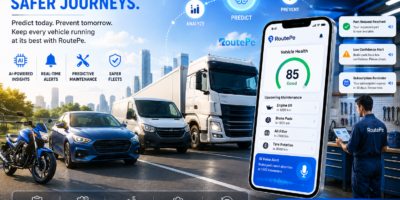
Artificial intelligence and machine learning can help analyse patterns that may not be immediately apparent to a driver. Instead of relying exclusively on a vehicle owner’s observations, an intelligent system can use its analytical models to assess patterns and generate predictive health scores.
These scores can help users understand the potential condition of their vehicles and identify areas that may warrant further attention.
The purpose is not to suggest that every developing mechanical fault can be detected remotely. Rather, it is to make vehicle health monitoring more accessible and provide an additional layer of information to support timely maintenance decisions.
For example, an indication that a vehicle may require attention can prompt its owner to arrange an inspection rather than postpone maintenance until a problem becomes unavoidable.
This can be particularly valuable for people who depend on their vehicles every day. A personal vehicle may be essential for commuting and family responsibilities. For a commercial vehicle operator, unexpected downtime can also mean missed deliveries, disrupted operations, and lost revenue.
Early awareness can make a meaningful difference in both situations.
An Entire Automotive Ecosystem Built Around the Struggling Vehicle
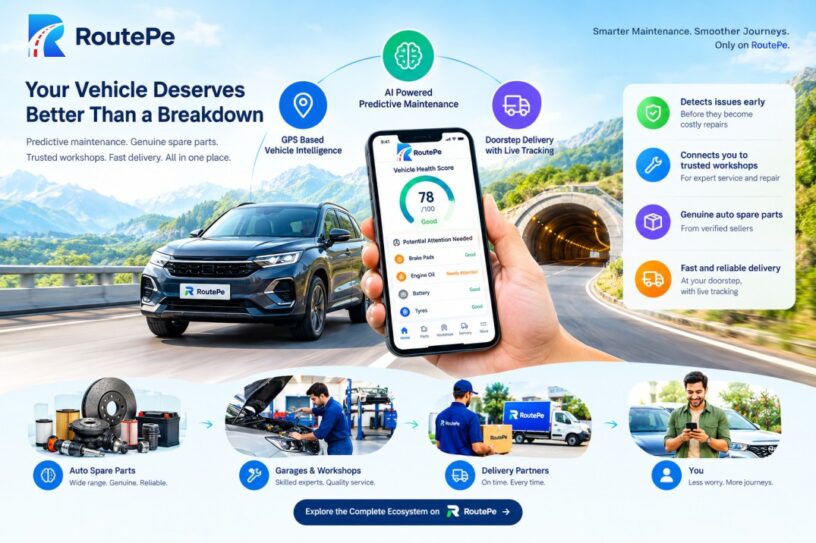
Identifying a potential vehicle problem is only the beginning. The real challenge often starts when the owner needs to find the right spare parts, locate a reliable garage or workshop operating on reliable Garage Management Software, and get the vehicle back on the road without unnecessary delays.
RoutePe is building a connected automotive ecosystem designed to support the struggling vehicle at every stage. By bringing vehicle owners, auto spare parts stockists, retailers, garages, workshops, and other automotive service providers onto one platform, RoutePe aims to connect vehicle intelligence with the people and businesses that can act on it.
The objective is to make spare parts easier to source, repair services easier to access, and the overall vehicle maintenance experience more convenient. Rather than treating predictive maintenance as an isolated technology, RoutePe connects it to the wider automotive aftermarket, helping bridge the gap between identifying a potential problem and finding the right support to resolve it.
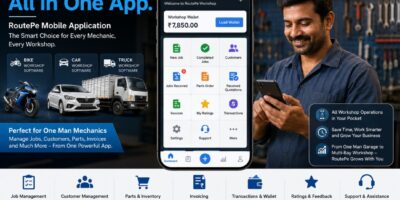
For vehicle owners, this means a more connected way to approach maintenance. For garages and workshops, it creates opportunities to connect with customers who need servicing and repairs. For spare parts businesses, it offers a digital channel through which parts can be discovered and orders can be generated.
The broader vision is to bring the different participants in the automotive ecosystem closer together, making it easier to move from a potential maintenance issue to a practical solution.
Critical Spare Parts Delivered to Your Doorstep With Live Tracking
When a vehicle needs an essential spare part, delays in finding and collecting that component can keep it off the road for longer than necessary.
RoutePe addresses this challenge by connecting spare parts procurement with delivery services, helping customers get critical parts delivered directly to their doorstep. With live tracking, customers can follow the delivery journey and gain better visibility into when their required components are on the way.
This can be particularly useful for vehicle owners arranging urgent repairs and garages or workshops waiting for parts to complete a job. A workshop that cannot obtain a required component may have to postpone a repair, keep a vehicle waiting, and reorganise its work schedule. Better access to parts and visibility into deliveries can help reduce some of these operational difficulties.
By connecting spare parts businesses on its Auto Spare Parts Inventory Software, customers, and delivery partners, RoutePe aims to reduce the friction between sourcing a required component and getting it where it is needed.
Combined with intelligent vehicle health monitoring and access to automotive service providers, this creates a more connected maintenance experience. The aim is to help vehicle owners and repair businesses spend less time coordinating the process and more time getting vehicles back on the road.
The Challenge of GPS Accuracy in Tunnels
GPS based intelligence offers significant possibilities, but it also has limitations.
Satellite positioning depends on receiving signals from satellites. When a vehicle enters an underground passage or a long tunnel, those signals can become weak or unavailable. The resulting location data may become less reliable, affecting calculations that depend on a continuous record of movement.
Consider a vehicle travelling through the Atal Tunnel near Rohtang Pass. While the vehicle continues moving normally inside the tunnel, its smartphone may be unable to obtain reliable GPS positioning.
A monitoring system that relies entirely on live satellite positioning may therefore underestimate the distance travelled or produce gaps in its recorded journey.
RoutePe addresses this challenge through intelligence designed to anticipate tunnel zones and compensate for missing distance where possible. This approach helps maintain continuity in distance estimation even when GPS signals are temporarily unavailable.
Nevertheless, compensation cannot guarantee perfect accuracy in every situation. The reliability of an estimate depends on the available information and the conditions encountered during the journey.
Being transparent about these limitations is important. GPS based predictive maintenance is designed to provide practical assistance under normal operating conditions, while exceptional environments such as tunnels may affect the precision of certain measurements.
The objective is to make the technology useful in everyday driving while continuing to account for the realities of how GPS works.
A More Proactive Approach to Vehicle Ownership
Vehicle ownership involves more than driving from one destination to another. It also involves managing wear and tear, maintaining reliability, controlling repair expenses, and making decisions about when and where to service a vehicle.
Predictive maintenance can help make these decisions more informed by providing early indications of potential maintenance needs. Connected workshops and spare parts networks can help owners take the next step. Delivery with live tracking can make the process of obtaining essential components more convenient.
Together, these capabilities represent a more connected approach to automotive care.
RoutePe brings these elements together with a focus on making vehicle intelligence and automotive services more accessible. Its approach combines smartphone based predictive maintenance with connections across the spare parts, workshop, and delivery ecosystem.
The technology does not eliminate the need for regular servicing, professional inspections, or responsible driving. Nor can it guarantee that every mechanical failure will be predicted before it occurs. Instead, it aims to give vehicle owners another useful source of information and a more connected way to act when maintenance is needed.
A vehicle may never be able to say that its brake pads are wearing out or that its engine oil needs changing. But intelligent monitoring can help bring potential problems to a driver’s attention, while a connected automotive ecosystem can help make the next steps easier.
That is the idea behind RoutePe: helping vehicle owners move from reactive repairs towards more informed maintenance, supported by the parts, workshops, and delivery services that keep vehicles moving.
Discover more at RoutePe.
