For most vehicle owners, maintenance begins with a problem.
A warning light appears. The engine sounds different. A service reminder arrives. A mechanic recommends replacing a part. Or a vehicle simply feels different during a journey.
By that time, the question is no longer whether maintenance is needed. The question is how much longer the vehicle could have operated safely and reliably before that maintenance became necessary.
Predictive maintenance changes this approach.
Instead of waiting for a problem or relying entirely on fixed service schedules, RoutePe looks at how a vehicle is being used and connects that information with the maintenance history of individual parts. The objective is simple: give vehicle owners a clearer understanding of what their vehicle may need, how much life may remain in important parts, and when attention may be required.
The result is a more informed way to look after a vehicle.
Maintenance That Follows the Vehicle
Every vehicle is used differently.
Two vehicles of the same model can have very different maintenance requirements because their mileage, driving patterns, operating conditions and service histories are different.
A fixed calendar reminder cannot fully reflect this difference.
RoutePe takes a mileage centered approach. The vehicle is registered within the application and its movement is tracked using the phone carried with the vehicle. As the vehicle travels, its mileage becomes part of the maintenance picture.
This allows maintenance information to follow actual vehicle usage rather than simply following the passage of time.
For an owner, this can make maintenance information easier to understand. Instead of seeing only that a service is approaching, the owner can see how much mileage remains before attention may be required for a particular part.
That small difference can change the way maintenance decisions are made.
A Health Score for the Vehicle
One of the most useful parts of predictive maintenance is turning complicated maintenance information into something that is easy to understand.
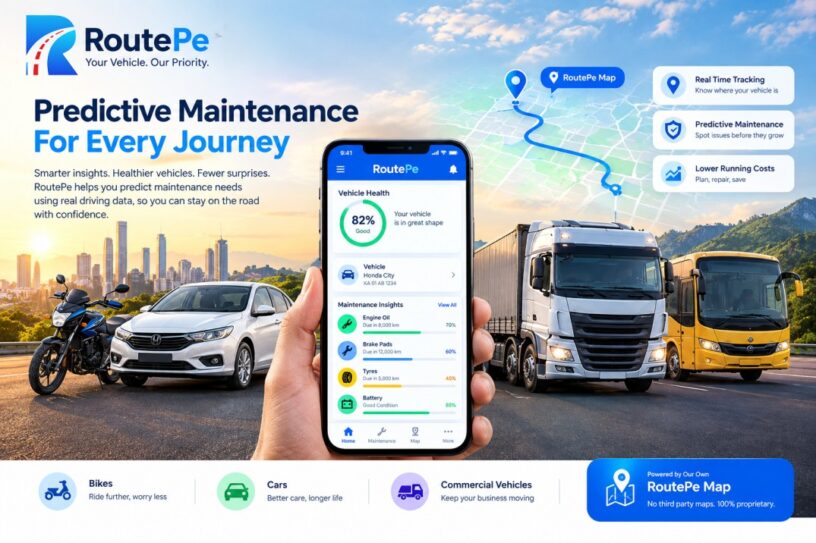
RoutePe provides a vehicle health score based on the condition and usage of the tracked maintenance items associated with the vehicle.
The application can show an overall health indication and present individual parts separately. A vehicle owner does not need to study maintenance records to understand the general condition of the vehicle. The information is presented as a simple health view.
A higher score indicates that the tracked maintenance items are operating within their expected usage range. As a part approaches its expected service interval, its health indication changes.
This creates a simple visual relationship between mileage and maintenance.
The owner can see what is operating normally, what may require attention later, and what may already require replacement.
Knowing What Is Left
Knowing that a part needs attention is useful.
Knowing approximately how much longer it can be used can be even more useful.
RoutePe displays remaining mileage for tracked maintenance items. If a part has an expected service interval and the vehicle has already covered part of that interval, the application calculates the remaining distance.
This means maintenance can become more proactive.
A vehicle owner may discover that a particular part still has substantial remaining mileage and can plan its replacement around an upcoming service visit. Another part may have much less remaining mileage and deserve attention sooner.
The difference is important because vehicle maintenance is rarely about a single moment.
It is about planning.
From Maintenance Records to Continuous Awareness
A vehicle does not have one maintenance event. It has a maintenance history.
RoutePe keeps maintenance information connected to the vehicle so that owners can build a continuing picture of their vehicle over time.
Parts can be added to a vehicle record, including parts selected from the available vehicle and part information. Owners can also request a part when they cannot find the required model or part in the available information.
Garage management information can also become part of the vehicle history.
This creates an important connection between what happens inside a workshop and what the vehicle owner sees later on the phone.
A replacement made during servicing does not simply disappear into an old invoice. It can become part of the vehicle’s continuing maintenance record.
Maintenance Based on Individual Auto Parts
Vehicles contain many components, and each component has its own expected service life.
That is why RoutePe does not treat vehicle maintenance as one single number.
The application can show individual maintenance auto parts, their expected mileage, remaining mileage and current health indication. Each part can therefore be viewed according to its own usage.
This provides a more detailed picture than simply saying that a vehicle is due for service.
For example, one component may still be operating normally while another may be approaching the end of its expected service interval. The owner can see these differences instead of treating every part of the vehicle as if it ages in exactly the same way.
Turning Warnings Into Action
Predictive maintenance is useful only when information leads to action.
RoutePe therefore connects maintenance information with clear guidance.
Depending on the remaining mileage and health indication, a part may be shown as operating normally, approaching service, or requiring replacement. When a component reaches a critical level, the owner can record that it has been replaced and move the item into maintenance history.
This creates a simple cycle.
A part is installed. The vehicle is used. Mileage accumulates. Remaining life changes. The application highlights when attention may be required. The owner replaces the part. The record moves into history.
The next maintenance cycle can then begin.
Over time, this creates a living maintenance record rather than a collection of disconnected service receipts.
Built Around the Smartphone
One of the fundamental ideas behind RoutePe is that predictive maintenance should not require owners to install additional equipment in their vehicles.
The smartphone already travels with most vehicle owners.
RoutePe uses the phone’s location information to understand vehicle movement and build mileage information around that journey. This makes the approach particularly relevant for owners who do not want additional devices attached to their vehicles.
The phone becomes the connection between the vehicle and its maintenance information.
At the same time, the mobile application makes the importance of keeping the phone with the vehicle clear. If the phone travels somewhere without the vehicle, the resulting movement can affect mileage information.
The goal is therefore not simply to collect movement. It is to make that movement useful for vehicle maintenance.
Our Own RoutePe Map
The journey itself is also important.
RoutePe has developed its own RoutePe Map rather than building the experience entirely around external map providers. This gives the platform greater control over how vehicle movement is understood and how location information becomes part of its maintenance experience.
RoutePe does not depend on third party map providers such as Google to define this core part of its product.
That matters because predictive maintenance is not just a mapping problem.
The map is part of a larger vehicle intelligence experience where movement, mileage and maintenance history need to work together.
By building this capability as part of RoutePe itself, the company can continue developing the experience around its own vehicle focused requirements rather than designing the product around someone else’s platform.
Maintenance That Understands Real Usage
The bigger idea behind predictive maintenance is not to tell vehicle owners that something might go wrong.
It is to help them understand their vehicle before a problem becomes urgent.
A vehicle owner should be able to open an application and answer simple questions.
How healthy is my vehicle?
Which parts are being tracked?
How much mileage remains?
Which component needs attention first?
What maintenance has already been recorded?
What was replaced previously?
RoutePe brings these answers together in one place.
That makes maintenance less reactive and more organised.
A Better Relationship With Vehicle Maintenance
Vehicle maintenance has traditionally depended heavily on memory, service intervals, workshop recommendations and paper records.
Predictive maintenance adds another layer: continuous awareness based on how the vehicle is actually being used.
It does not remove the need for professional inspection. Physical vehicle conditions can vary because of road conditions, environment, driving behaviour and many other factors. GPS information can also be affected by reception and device handling.
Instead, predictive maintenance provides another source of information that helps owners plan better.
It gives the vehicle a history.
It gives individual parts a remaining mileage.
It gives the owner a health view.
And it provides reminders when maintenance deserves attention.
The ultimate purpose is simple.
A vehicle should not have to surprise its owner before it receives care.
With RoutePe, maintenance becomes something owners can understand continuously, monitor through everyday vehicle usage and plan before the next problem arrives.
That is the idea behind predictive maintenance: moving from waiting for the vehicle to ask for attention to understanding when attention may be needed before it becomes an emergency.
