

The modern agricultural landscape demands machinery that delivers high performance, durability, and operational efficiency. Purchasing a new tractors is a major capital investment for farmers, commercial operators, and fleet owners. To help buyers navigate this decision, RoutePe provides key technical insights designed to simplify every stage of the evaluation process. Understanding the crucial technical factors ensures that every buyer selects a machine perfectly aligned with their specific operational needs.
Purchasing a new tractor involves far more than just picking a reputable brand or matching a budget. Equipment performance relies heavily on how power, transmission, hydraulics, and drive configurations work together under real field conditions. Furthermore, managing statutory compliance, pre delivery inspections, ownership costs, and mobile app integration ensures that your machine yields maximum return on investment over its entire operational lifetime.
Engine Power, PTO Capability, and Displacement Mechanics
Evaluating engine performance requires looking beyond total horsepower ratings. While engine power indicates overall machine capacity, Power Take Off performance directly dictates how effectively implements like rotavators, threshers, and balers operate. A well engineered transmission system must transfer at least eighty five to ninety percent of total engine power directly to the implement drive unit to prevent energy loss during heavy field passes.
Engine displacement measured in cubic capacity plays an equally vital role in longevity and fuel efficiency. High cubic capacity engines designed to operate at lower rated revolutions per minute, typically between eighteen hundred and twenty one hundred RPM, deliver prolonged durability under heavy loads. Operating at lower engine speeds reduces internal component wear, lowers thermal stress, and optimizes overall diesel consumption during demanding operations such as field preparation and puddling.
Selecting the Right Transmission and Gear Configurations
Transmission design directly influences operator comfort, gear longevity, and field productivity. Standard sliding mesh gearboxes are increasingly obsolete for heavy agricultural tasks due to higher gear wear and difficult shifting. Modern buyers should prioritize Partial Constant Mesh or Full Synchromesh gearboxes to eliminate shift chatter and prolong mechanical life.
Gear selection versatility is crucial when matching travel speed to specific field applications. Opting for gearboxes offering twelve forward plus three reverse or fifteen forward plus three reverse options provides precise control across various soil conditions. Pairing these multi speed transmissions with a Super Shuttle forward reverse lever enables rapid direction changes, making front loader operations and headland turns far more efficient.
Hydraulic Lift Systems and Automatic Depth Control
Hydraulic system capability defines how well a tractor handles heavy mounted implements. Buyers must look for Automatic Depth and Draft Control systems equipped with dual sensing points on the top link mechanism. Dual sensing allows the hydraulic system to make precise, automated adjustments to implement depth as soil resistance changes, ensuring consistent tillage depth across varying soil textures.
Matching hydraulic lifting capacity to your heaviest implement is critical. Whether operating a three bottom mouldboard plough or a reversible laser land leveller, ensure the system handles loads ranging from fifteen hundred to twenty five hundred kilograms effortlessly. Additionally, secondary auxiliary spool valves with quick release couplers must be present to operate hydraulic tipping trailers and advanced hydraulic field tools.
Drive Configurations for Regional Soil Conditions
Choosing between two wheel drive and four wheel drive models depends largely on regional soil types and primary application needs. Four wheel drive configurations excel in wet land cultivation, particularly for paddy field puddling, as well as in dense black cotton soils. By engaging all four wheels, traction increases significantly, reducing wheel slippage by up to thirty percent while cutting down fuel consumption and field working time.
Conversely, standard two wheel drive tractors remain ideal for dry land farming, row crop cultivation, inter cropping, and regular highway haulage. Equipped with heavy duty straight or portal front axles, two wheel drive machines deliver dependable service at a lower initial cost and require simpler ongoing maintenance for general transport tasks.
Emission Compliance and Statutory Regulations
Tractors in India operate under strict regulatory frameworks dictated by Central Motor Vehicles Rules and evolving emission guidelines. Machinery outputting over fifty horsepower transitions to advanced emission standards that incorporate exhaust gas recirculation, diesel particulate filters, or selective catalytic reduction systems to minimize environmental impact.
Registration classifications also require careful verification during purchase. Using an agricultural tractor for commercial haulage, such as transporting bricks, sand, or construction materials, mandates registering under commercial vehicle tax rates, obtaining national permits where applicable, and installing commercial electronic toll passes. Mandatory safety features including roll over protective structures, hazard lights, side reflective tapes, and rearview mirrors must be fully functional for road transport safety.
PTO Operational Modes for Maximum Efficiency
Power Take Off systems with flexible operating modes significantly increase implement efficiency. A standard setting delivers five hundred forty revolutions per minute at full rated engine speed, which is necessary for driving power intensive equipment like heavy rotavators.
However, selecting an economy mode allows the system to achieve five hundred forty revolutions per minute at significantly lower engine speeds, usually around fourteen hundred to sixteen hundred RPM. Using economy mode on lighter loads like water pumps, sprayers, and light mowers saves up to twenty percent on diesel consumption. Models featuring reverse rotation capabilities allow operators to clear implement jams easily without manual effort.
Essential Pre Delivery Inspection Protocols
Before signing final acceptance papers at the dealership yard, buyers must perform a comprehensive pre delivery inspection. Verify that chassis, engine, and rear axle serial numbers match official sale certificates, roadworthiness documentation, and tax invoices perfectly.
Conduct operational checks to evaluate the hydraulic three point linkage under load to ensure zero lift drift or cylinder leakage. Fluid levels including engine oil, transmission fluid, coolant, and wheel hub oil must be verified alongside dry air filter clogging indicators. Finally, inspect tire dimensions, ply ratings, and inflation pressures to confirm there are no sidewall defects. Ensure essential items like top link bars, drawbars, toolkits, and warranty books are delivered with the vehicle.
Total Ownership Costs and Smart Features
Evaluating a tractor extends past the initial purchase price to consider maintenance costs and resale value. Check service interval requirements, such as engine oil change frequencies ranging from two hundred fifty to five hundred hours, along with localized spare part pricing. Selecting brands with strong regional presence ensures high resale value across rural market hubs.
Modern tractors also incorporate OEM telematics systems providing live tracking, geofencing, engine runtime analytics, real time fuel level alerts, and automated maintenance reminders accessible straight through smartphone applications.
Convenient Digital Access via RoutePe Mobile Application
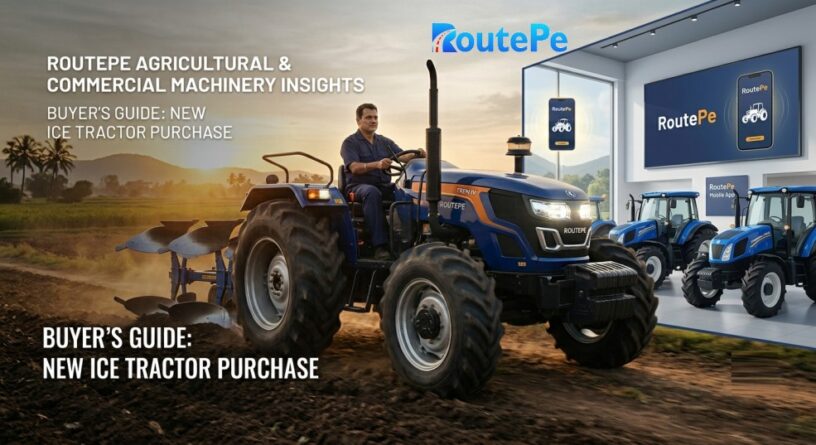
Finding, comparing, and buying the ideal tractor is simpler than ever thanks to modern digital solutions. The new tractors highlighted throughout this guide are listed directly on the RoutePe Mobile Application, serving as our main unique service proposition.
Instead of visiting multiple physical dealerships to compare specifications, farmers and fleet owners can open the RoutePe Mobile Application to explore complete technical details, compare models, and review transparent pricing right from their mobile devices. The platform bridges the gap between buyers and high performance agricultural machinery, delivering an effortless digital experience tailored to modern farming needs.