

A Small Fleet, A Large Footprint
In India, trucks form only a tiny share of the total number of vehicles on the road. Yet they are responsible for a disproportionately large share of transport-related pollution. This imbalance highlights an urgent issue within the logistics sector—how essential goods movement is colliding with environmental sustainability.
Why Trucks Pollute More
Heavy-duty trucks run long distances every day, often carrying massive loads. Most rely on diesel engines, which emit higher levels of particulate matter and nitrogen oxides than petrol vehicles. Many trucks in operation are older models with outdated emission systems. Combined with inconsistent maintenance, overloaded cargo, and stop-and-go highway congestion, emissions multiply quickly.
Unlike private cars, trucks also spend far more hours on the road. One long-haul truck can burn fuel equal to dozens of passenger vehicles in a single day. This is why a small number of trucks can generate a large share of pollution.
The Hidden Cost to Health and Economy
High particulate emissions affect air quality in cities, highways, and industrial corridors. Poor air quality increases respiratory illnesses, reduces worker productivity, and raises healthcare costs. Businesses ultimately bear indirect costs through delays, damaged goods from inefficient transport, and stricter environmental regulations.
A Cleaner Road Ahead
Cleaner trucking does not mean fewer trucks, it means better trucks. Regular maintenance plays a major role in reducing emissions. Well-tuned engines, timely oil and filter changes, proper tyre pressure, and clean fuel systems help trucks burn fuel efficiently and release fewer pollutants. Replacing worn-out or faulty components, such as injectors, turbochargers, air filters, and emission-control parts like catalytic converters and DPF units, can significantly cut particulate and nitrogen oxide emissions.
Technology also has a strong role to play. Route optimization reduces empty runs and fuel waste. Load consolidation improves truck utilization. Digital inspection records ensure that critical parts are serviced on time. Fleet owners who invest in preventive maintenance often see lower fuel costs, fewer breakdowns, and longer vehicle life.
In India, improving truck maintenance standards across the industry can quickly reduce pollution without slowing economic activity. Cleaner trucks are not just good for the environment, they are good for business. Efficient vehicles save money, improve reliability, and build trust with customers.
RoutePe Auto’s Mission
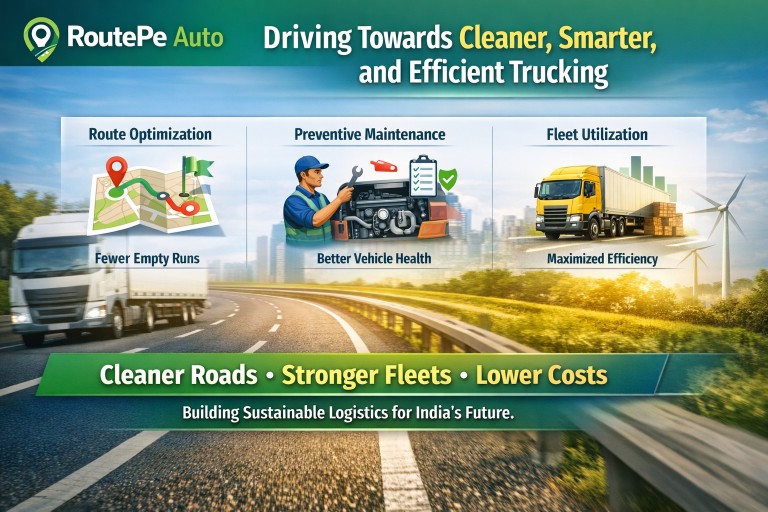
At RoutePe Auto, our mission is to make trucking cleaner, smarter, and more efficient through route optimization, preventive maintenance awareness, and better fleet utilization.
We help transporters reduce empty runs, track vehicle health, and replace critical parts on time to cut fuel waste and emissions.
Cleaner roads, stronger fleets, and lower costs, building sustainable logistics for India’s future.
Sustainable trucking is not just an environmental responsibility; it is a business opportunity. Companies that adopt efficient logistics today will lower costs, improve reliability, and contribute to cleaner air tomorrow.
